At the current state, the laboratory structure can be said to resemble closed-structure, encapsulation model of the national science entities, and some of the component and organization are taken from the coursebook of the Russian, or the Soviet scientific community at the national level. Given such, it is rather interesting to present the content and thereof, of the accordingly both complex, yet also simple, structure of the inquiry itself.
Abstract
Based on the structural evolution taken thereof, there is the need to provide laboratory structure, and how everything is formed of the current structure, for clarity and navigation. This document and page is dedicated to explain such.
Aware version
The document is currently managed and maintained in version Phase I, i.e. continual update in the realm and domain of Phase I of the coverage of the laboratory. Further specification and information would be added in later version, if such is permitted, under the current form or not given no information are to be deleted, such is to only added and requisitioned elsewhere, as noted.
I. Laboratory components
Please also refer to
DOC-OR(-PROP)-08for this specific purpose, and origin of the design template. For many sections of which,
The laboratory model is inherently top-down under influence and ownership. That is, it goes as the following main core central line.
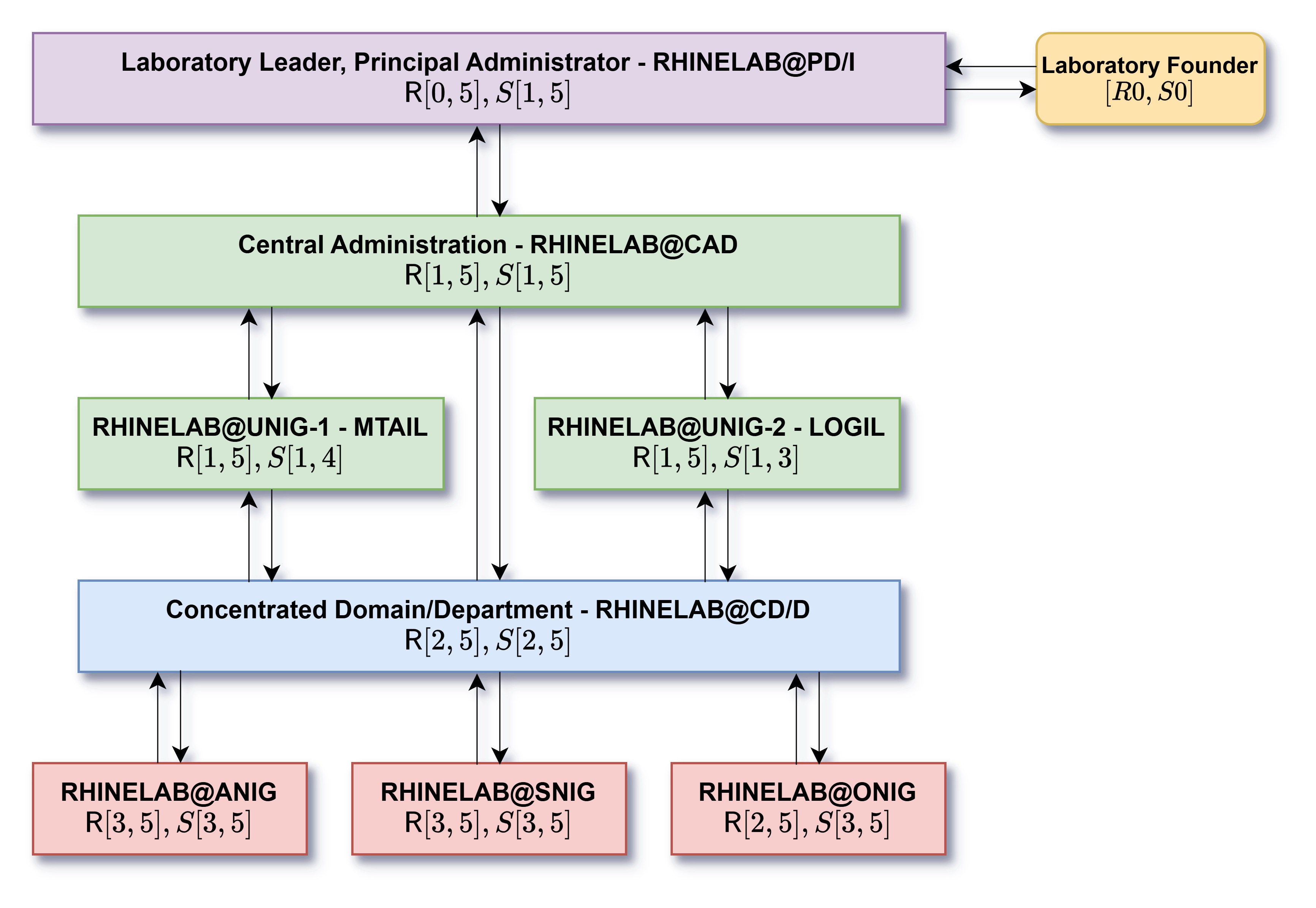
A. Laboratory Leader, Principal Administrator (RHINELAB@PD/I)
The role here is similar to what you would call and usually say as CEO, though we should not call it as such. By ownership, the Laboratory Founder holds all functional, institutional and correlated, shared intellectual properties or private and single-owned intellectual properties or creations. Even though RHINELAB operates on mainly open-source dissection, such inquires non of the require for the work to be non-open-source aside from the mandate that works should be of the ratio partition of open-source, semi-open-source and closed-source works and intellectual amounts. The principal administrator here is, of the present tense and all, Bui Gia Khanh as also its founder. It is then wise to state, and often better of admission, to say that the Principal Administrator and so far, as its founder, such would not be a role of a manager, but also an active researcher as he is, and is, of a person with his philosophies and so on. He is as much scholar as he is a manager, and should he be, he must then be capable, often time, to realize the balance of which is the human and the logic side of talk. Under such, if the founder and so on of principal administrator is unable to take ahold of such, he would be left with options of suspension of additions on moderations, provisions thereof, and only left of maintenance of RHINELAB, i.e. cold state, meanwhile RHINE@CAD would also be suspended of such, however with moderations, provisions, and maintenance level of which does not penetrate the major institutional state suspended of the time, minimally for existence. Until such is resolve, it would be strictly institutional and should not penetrate into either the philosophical pillar specified universally, or should it be so, of the operational academic activities unless inquired or involved.
The importance of the philosophical barriers
If the institution and its overreaching system cannot exist under its own philosophy, and much of its survival condition, then, continuity must stop. RHINELAB would cease, by then, of its existence and is replaced of its record. To exist without its own philosophy is not RHINELAB, but another subject in entirety, and should be marked of such per its respect of history and observers therebe.”
The implication and ownership (the short version)
Basically, it says if you work with us, you better be damn that you involve us in your credibility of what we do and what we provide, not just financial resources or so but logistics, hosting, and providing your academic working space. We also have saying in your own matter at hand of what you produce inside the laboratory, will be of the laboratory but with you on the record as to influence its usage as the creator and primary researcher or so, if that even applies in regard to the internal lab, and the external lab usage under constraints settled. Like, licenses and open-source mandate.
The implication and ownership (the long version)
Subject produced under RHINELAB falls under the jurisdiction and ownership, shared but majoratively on the RHINELAB side for its founder, if not specified otherwise, at least 40% on such matter. In exchange of the cooperation thereof alongside participation, works and support, intellectual participation, portion amounts and fair use of such, would be inquired and ensured unless stated otherwise on RHINELAB side. That is, we are to enquire ownership, major partial or total, control and saying, of the subject, for resource donated in full, for rights of use in which asymmetrically such would be inverted on reverse ground except stated otherwise or of suspicious of violation and vindication in which try to remove RHINELAB’s 60% share on which defined and stated of non-open-source technology or intellectual resultant, for matters of which is contributed, in exchange for institutional recognition, free for publication and creditability, institutional mass given operations inside laboratory infrastructures, branding and rulesets exhibited of such, support of infrastructure both technically and intellectually also resource-wise, and insurance of academic freedom under genuine apprehension of such. Temporal classification as in patent system is applied, based on default signaturalization of design template or any replication-related activities (as also mandated of realization for
RHINE@UNIG-LOGILresearch unit under research of said method of serialization), and contribution weight in which is calculated with reduced weight from institutional computation of material resources, but not eliminated. The key goal, as for such inquisition in nature, should be and is, the ownership of majorly, open-control, and, alongside and in which support of the open-source nature in its partition, open-signature participation credition, and the non-removability of such under any circumstances, extended in all of its footprint.
If it is to say about the above implication thereof, extended also to RHINE@CAD, then it is simple. We fear loss of open-control, but more so the fear of historical erasure. In a sense, you cannot remove those of which to give you spoon that you feed your meal in. Your contributions, creations, and thereof, either of the lone genius taken in, or a rogue one in rebellion, are not, in any sense, capable of inventing anything alone. The myth of the lone genius is not real nor it is practical, for it, to rely on its own sustainability, be it parents, be it teachers, of the benevolent people of which is very rare and even in such a case, such would be of rhetorically despicable to remove such teacher from ever being credited for even helping the person following him. If such person is to be alone, truly alone, then he must fend for himself, eat for himself, make everything of himself, of theoretical visions, of which to enquire no intellectual palace to stand, the room to think, bored of hunger, bored of bureaucrats, constrained by resources, lack of times. All of such, are not alone, and should, under least condition, be recognised of such. In position of the adversarial from such, is perhaps quite so, the act of naivety, irresponsibility, treacherous removal of identity and existence under either normal or philosophical mention, and simply against everything scientific discourse and existence of even the action of science is for, if we take it more than just mainstream to extend very close to the term philosophy there is.
B. Central Administration (RHINE@CAD)
Often abbreviated as RHINE@CAD (or so just for everything of RHINELAB@ in syntax), the central administration is the core structural system that is of use for RHINELAB and its operational strength.
The function of CAD is varied, but often times of such, it maintains the larger:
- Functional and autonomous, generalized and compartmentalized logistical system and institutional generation system used for RHINELAB’s intellectual activities.
- Principles and theoreticals on matters concerning RHINELAB’s operations, laboratory operations, and the scientific theories in general.
- Institutional research, i.e. the research on institution, systems of intellectual activities and humanitarian concentration12.
- Maintenances and bookkeeping, operational reduction, in general institutional building and recheck.
- Maintain research on fundamental science and network system control.
Those are some of the core operational 1s and tasks that CAD should take into account alongside their own philosophy. Role assignments follows, with its core the Administrator of CAD in its core, which can be of at most four seats. One seat is permanently occupied by the Principal Administrator 3. Planning and general macro-structures are not permitted to be changed by any members of CAD, aside from major consensus and Principal Administrator’s agreement. This is not a democracy, you know.
Under the composition of RHINE@CAD, there then exists three, with the included third in development at the time of writing this (of a plan to finish formation theoretical by 2027), listed in UNIG - Named Laboratory, of classification UNIG.
UNIG-01, MTAIL (Modelling Theory, Artificial Intelligence and Learning-theoretic Laboratory)
The unit RHINE@MTAIL, focused on modelling theory, general artificial intelligencer research of both theoretical and philosophy, and learning-theoretic development such as symbolic learning theory and statistical learning theory, or alternative learning theory at such. Their work focuses on, for now, hinges on:
- Theory of modelling, reformation and reclassification of models and their importance order.
- Artificial intelligence and its theoretical treatments, applied AI system analysis. Specifically negative research against AI developments.
- Learning theory, including statistical learning theory and symbolic learning theory (1950s-1990s) as its central study.
Majority of all works from RHINE@MTAIL is impervious of the core work and research of the lab. Thus, it takes absolute precedence over all else when it comes to academic research and core functional.
UNIG-02, LOGIT (Logistics, Operational and General Infrastructure, Template Laboratory)
Logistic branch of the UNIG system. They handle the theory of institutional logistics and the theory of human and scholastic logistics, and maintenance of RHINELAB’s logistical system. Their capacities define how much can they extend of the laboratory, at any given time.
UNIG-03, GTPR (General Theoretical and Principal Resolution Laboratory)
They are the general theoretical research branch. This ranges from institutional theory research, functional laboratory research, template of the institutional and various form of operational core, code of conduct, communication protocol in academic research, philosophical grounding and debate on institutional workings, and more of non-institutional works, for example, philosophy of science and philosophy of scientific research, and so on. This group is currently non-operational.
C. Concentrated Domains and Departments (RHINE@CD/D)
This organization is one-step lower than the previous one. The philosophy here is rather, no pun intended, concentrated, and much
Footnotes
-
Here, humanitarian concentration strictly means, not extended to otherwise, human-centric configuration and assessment of a particular activity hub in which human-to-human interaction is classified as high-intensity, and as also there exists both polar of the separability condition, and humanizing condition. ↩
-
As above stated of the first footnote on the humanitarian classification, clarification of such should be delivered in the same time. By high-intensity classification, we believe that intellectual community, research laboratory, and many of the institutional system of scholastic nature, resides intrinsic non-collapsible and often time natural identity interaction, between identities of humans, different people and their own archetype, so much so also the oppositions thereof. In doing so, institutional system faces two calamities thereof - either would they switch to separability conjecturation where one would conjecture and actionalize on separation of identity from functions, to preserve their oppositions and of which identity, intellectual mass in which they define as of their worldview, material view, and existential view. On the other side, such would be enquired of the opposition to those being humanization conjecturation, where one goes for humanizing the system, enforcing identity extension, acknowledgement of identities baseline, basis, and what to form of the institution to replicate of which fundamentally human-qualities like empathy, facilitation on analytical viewport of emotional response, irreducible stance on the analytic of human as quantification or categorization (such as, for example, psychological diseases as a total proxy for erratic behaviours), and communal preference. Such would be the gauging thereof that is required of which CAD would have to put theoretical, and to put practical into effect. ↩
-
The design here is particularly pointed to a system of delegated control. By default, while exercising power of the Principal Administrator waives under structural condition of any pushback from the below system, such would be not preferable for natively solvable solutions. Under administrative works and the meta-linguistic thereof for the laboratory system, should it be inquired, the Principal Administrator, and thus subsequently, administrative personnel, shall exercise local enforcement condition, if available (which should be made available of all time) unless required under assessment otherwise, to not exercise abundance of administrative power where such is not necessitated of the preliminary conditions. ↩